


The Gallery
John had managed to get a show at a very high-end gallery on Miami Beach—Samathan’s Fine Arts, or something close to that.
It was a big deal.
Not because galleries were easy to come by—but because this one was taking a real risk. At the time, surrealism wasn’t something people were walking in asking for. It wasn’t decorative. It wasn’t obvious. It asked something from the viewer, and most buyers didn’t want to work that hard.
From the beginning, there was tension.
The work went up, the opening came and went, and nothing sold. You could feel it—her concern, the pressure building, that quiet realization that this might not land the way she had hoped.
John wasn’t shaken.
“You have to let people think about it,” he said. “It’s like buying a car.”
But that’s not how galleries work when nothing is moving.
The call came soon after.
“We need to reduce the price.”
John had spent real time on those paintings. They weren’t quick, and they weren’t easy. He let her finish, then answered plainly.
“No,” he said. “We just went up thirty percent.”
There was a pause.
That wasn’t the answer she expected.
The next night, John showed up about thirty-five minutes late. There was a great restaurant next door, and when he saw a crowd outside, he assumed they were waiting for a table.
He walked in.
And everything had changed.
The same gallery owner who had been pushing to lower prices came straight up to him—completely different energy—and gave him a kiss.
“We sold two.”
He looked at her.
“At the price you told me on the phone.”
He glanced around the room, now full.
“How did you get all these people?”
She didn’t.
The critic did.
The main art critic in Miami had come through, taken one look at the work, and absolutely hated it. He wrote a brutal article. Tore it apart.
But he had a reputation.
A lot of people in the art world didn’t agree with him.
So they came.
Not to support him.
To see it for themselves.
And once they did, everything shifted.
The room filled. People stayed longer. Conversations started. The same work that had been passed over the night before suddenly had weight.
By the end of it, they didn’t just sell two.
They sold four.
Just like that.
What had been a risk became momentum almost overnight.
Mr. Rusken
Around that same time, something else began to happen—quieter, but far more important.
The right people started finding John.
One of them was Dan Rusken.
By then, John was living on Pine Tree Drive, in one of those large Miami Beach estates that carried a certain presence without needing to show it off. Marble, space, room to think—the kind of house that reflected where things had gone, and where they were still going.
And inside that house was the garage.
Eight cars wide, but it had turned into something else entirely. Airplane parts scattered around, fragments of wings, objects John had picked up because he liked to take things apart and understand them. Paintings leaned against the walls—finished, unfinished, somewhere in between. Easels mid-process. Nothing arranged for presentation, but nothing without purpose either.
It was where the work actually lived.
That’s where Dan chose to sit.
He was already a billionaire by that point, one of the men responsible for shaping Miami Beach into what it had become—pumping sand, creating land, building the causeways that connected it all. He understood value because he had built it.
But when he came over, none of that followed him in.
He’d walk through the house, past everything designed to impress, and head straight to the garage. To that oversized chair John had found—ornate, heavy, almost like something from another era—and settle in like it belonged there.
Then he’d stay.
Sometimes talking. Sometimes not. Mostly just watching.
If something caught his attention, he gave it time. If he didn’t understand it, he’d come back to it. Over the years, he had built his way of thinking the same way—writing down words he didn’t know, looking them up, memorizing them. It showed in how he took things in.
For a while, he bought everything.
If John needed money, Dan didn’t complicate it—he’d take another piece. It became a rhythm, one that gave John the space to keep going without interruption.
Remnants of Power
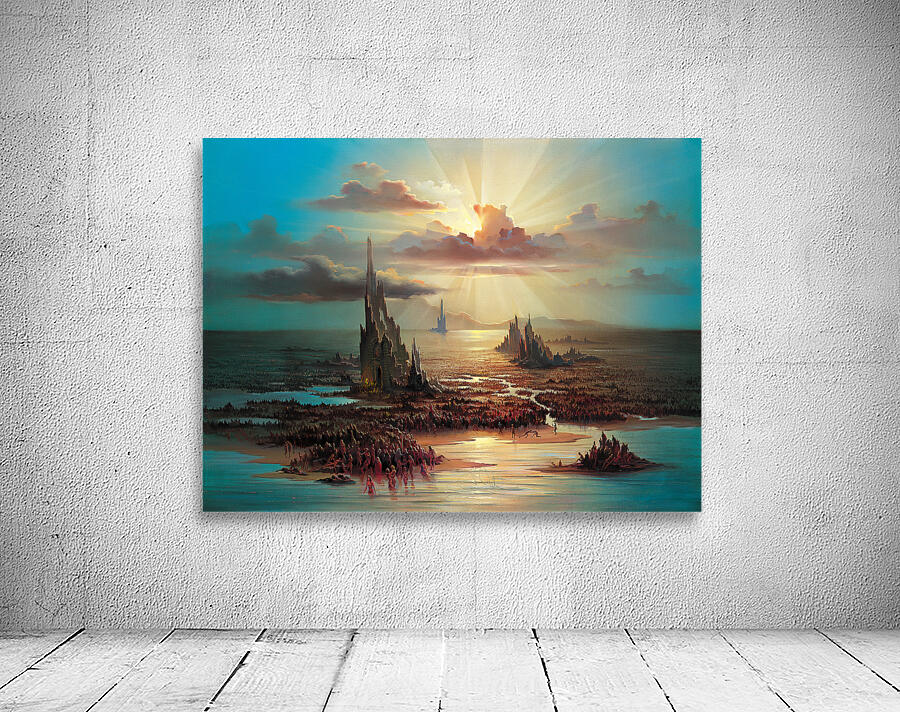
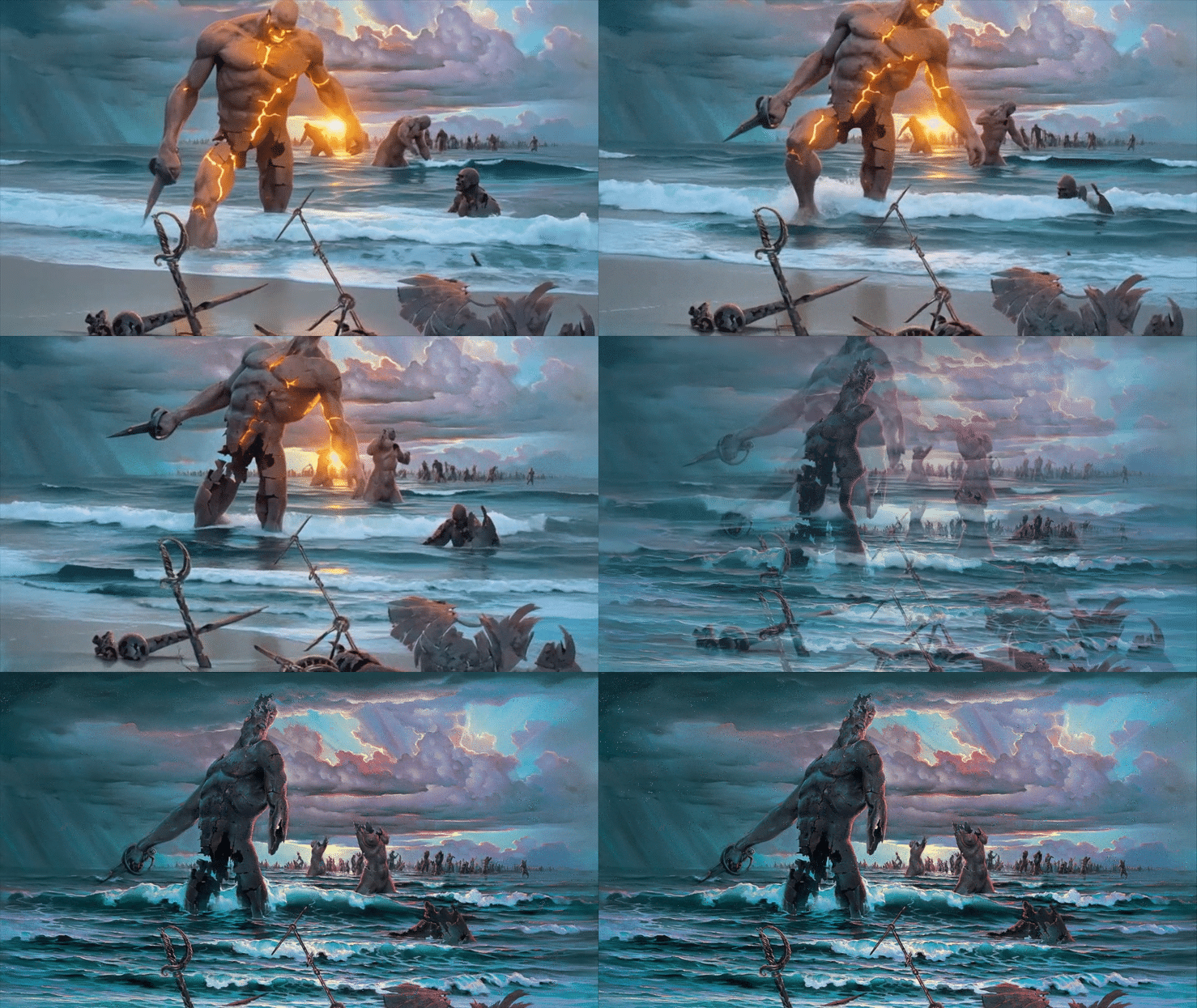
Remnants of Power had already been finished by the time Dan started coming around.
It came out of an earlier chapter—John’s time in the military—when structure, discipline, and force weren’t abstract ideas. They were lived. You saw how things were built, how they held, and how quickly they could break apart.
That feeling stayed with him.
The painting carries it.
Figures rising out of the water, worn down, fractured, still standing but no longer whole. Not dramatic. Not loud. Just there—like something that had already been through it.
It wasn’t about destruction.
It was about what’s left after.
Dan stood with it for a moment, taking it in.
“That’s mine.”
And that was that.
Domination of Power
Domination of Power was painted later, around 1972, while John was living on Pine Tree.
By then, Miami was a different world.
Big personalities. Big money. People who moved fast and didn’t ask for permission. You saw it everywhere—in the deals, the conversations, the way certain people carried themselves. They didn’t explain what they were doing.
They just did it.
That energy found its way into the work.
The herd moves with purpose. Nothing scattered. Nothing uncertain. Each piece holding its place inside something larger, all of it moving forward without hesitation.
Dan saw it while it was still part of the garage—unframed, leaning with everything else.
“Those are good,” he said.
He pointed. In typical Dan fashion.
“That one’s mine.”
No discussion.
Over time, pieces like Domination of Power and Remnants of Power, found their way into Dan Rusken’s collection. Today, a number of works from that period are understood to trace back to his estate—just a small glimpse into what was, at the time, a much larger body of work he quietly acquired.
For collectors who have followed these pieces over the years, there is still ongoing communication with the Rusken estate.
What Happened Next
In those early years, the work moved quietly.
A few collectors. A few rooms. Decisions made without much discussion, just a sense that something was there.
That was enough to keep it going.
But it didn’t stay contained for long.
The same instinct that brought people into that garage began to pull the work outward—beyond private collections, beyond one-off pieces, into something that could travel.
What had started as a conversation between artist and collector was about to become something much bigger.