

Restrictions: The Painting That Refused to Burn
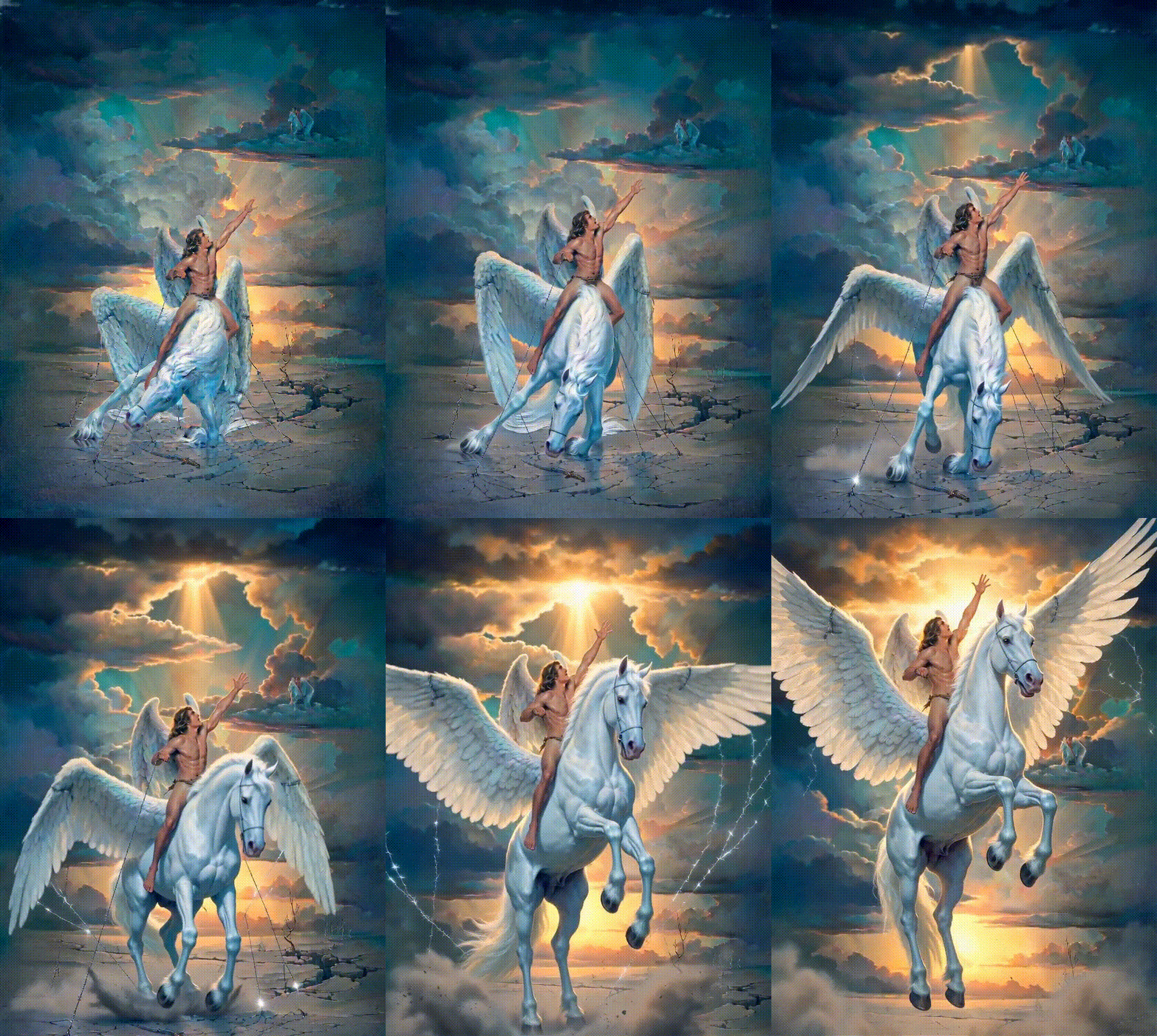
Consciousness & Light begins with the extraordinary true story behind one of John Pitre’s most iconic works: Restrictions.
Some paintings tell a story. Others become one.
In Episode 1, Anna Covert sits down with John Pitre to explore how Restrictions became more than a painting. It became a national symbol of resilience, crossed paths with power and wealth, survived the 1980 MGM Grand fire, and continued rising through history.
The Meaning Behind Restrictions
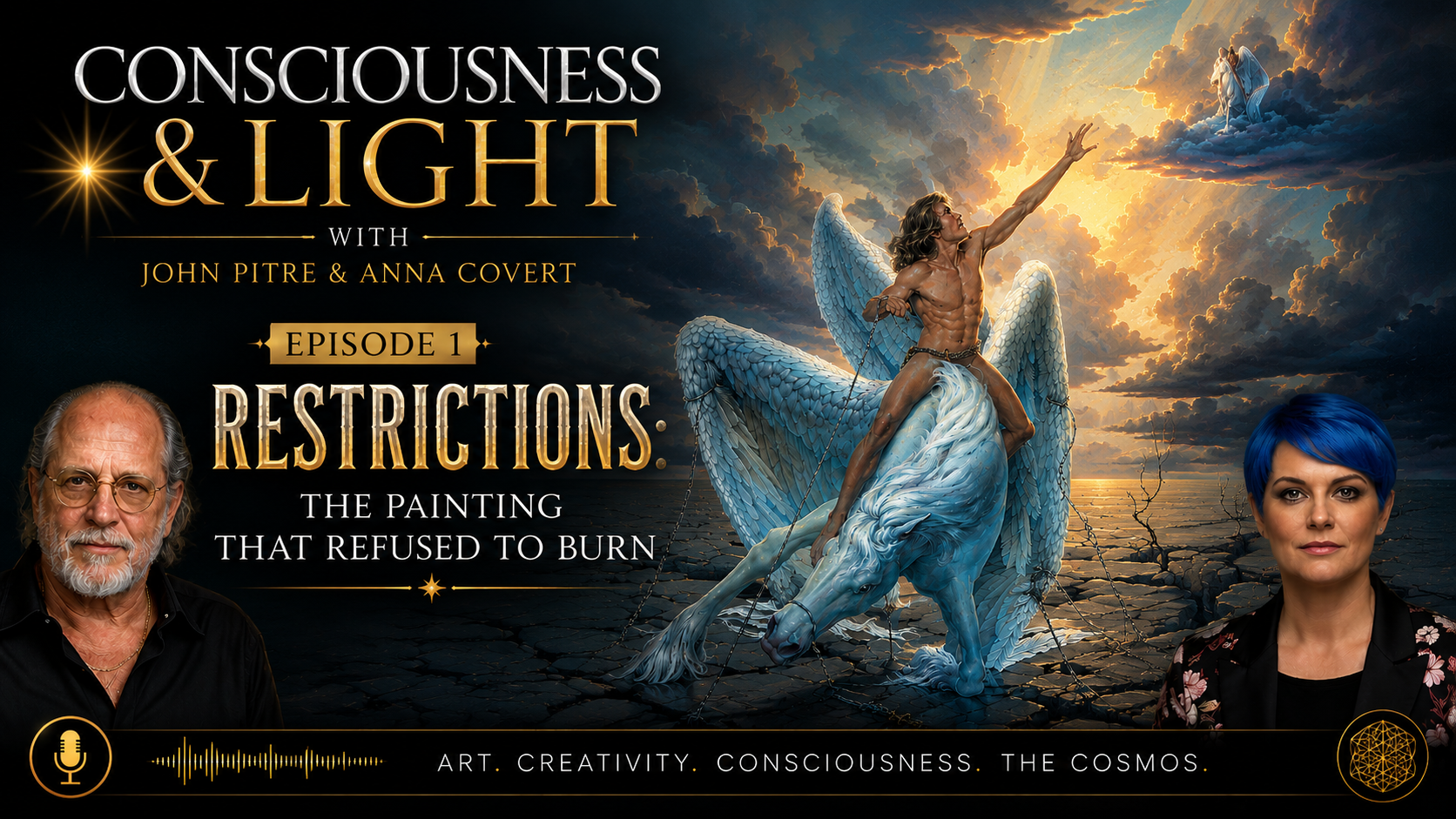
At the center of Restrictions is a rider mounted on Pegasus, the mythological winged horse. The rider represents humanity. Pegasus represents our dreams, hopes, and highest potential. The silver ropes tethering the rider to the earth symbolize the limitations and obstacles that hold us back.
Above him, the rider sees a version of himself that is free.
That image is what makes the painting so powerful. It asks a universal question: what is keeping us grounded, and what would happen if we finally broke free?
How the Painting Became a National Symbol
The story of Restrictions soon moved far beyond the art world.
Edward M. Curran, president of the International Conference of Police, immediately understood the painting’s message. To him, it represented struggle, endurance, sacrifice, and rising above limitation.
Curran helped bring Restrictions into a national fundraising effort supporting families of police officers killed in the line of duty. Thousands of prints were produced and distributed across the country, turning the image into a symbol of hope and strength.
The Rockefeller Opportunity
The influence of Restrictions eventually reached Nelson Rockefeller, who recognized the significance of the work. There were serious discussions about placing the painting in the Metropolitan Museum of Art in New York.
For John Pitre, it could have been a career-defining institutional moment.
But when Rockefeller passed away, the opportunity disappeared almost overnight. The museum placement ended, and the momentum vanished.
Still, the story of Restrictions was far from over.
The Mysterious Collector Named Jim
Later, John was approached by representatives from the West Coast. They handed him first-class plane tickets and cash before fully explaining why.
He was flown to California, taken to a massive estate, and told only, “You’re here to meet Jim. You’ll know him when you see him.”
After days of waiting, John finally met Jim, a powerful and mysterious collector who immediately connected with the work. Jim purchased Restrictions and several other paintings, paying more than John had even asked.
The MGM Grand Gallery
Not long after, John was flown to Las Vegas, where Jim took him to the MGM Grand Hotel and revealed an art gallery inside the property.
“It’s yours and mine. I bought it.”
Suddenly, John Pitre’s work was being shown inside one of the most famous hotels in Las Vegas. Guests, collectors, tourists, and high rollers passed by daily. The gallery thrived, and Restrictions remained at the center of it all.
The Fire
On November 21, 1980, the MGM Grand Hotel caught fire. Smoke filled the building. Guests evacuated. Chaos overtook the property.
Inside the gallery, the paintings were still there.
Including Restrictions.
The artwork that symbolized overcoming limitation was suddenly facing destruction itself.
The Unknown Runner Who Saved the Painting
As police sealed the area, Tina, who managed the gallery, spotted a young runner nearby. She offered him more money than he would make in two years if he would go into the building and rescue the paintings.
He looked at the fire and said yes.
He ran past the police, disappeared into the smoke, and came back out with a painting. Then he went back in again. And again.
Among the works he saved was Restrictions.
Then, just as mysteriously as he appeared, he disappeared. No one ever found out who he was.
A Painting That Lived Its Message
Years later, Restrictions resurfaced through gallery channels and was eventually acquired by a hedge fund executive for more than $1.25 million.
But its true value has never been only financial.
The power of Restrictions is that the painting did what it was created to symbolize. It endured. It survived. It rose above.
As John shares in the episode, restrictions are not always there to stop us. Sometimes, they are there to define us.
Watch Episode 1 of Consciousness & Light
In this premiere episode, John Pitre and Anna Covert explore the remarkable true story of Restrictions, the meaning behind the artwork, and why its message continues to resonate with artists, dreamers, and seekers of light.
Explore the story: The Story Behind Restrictions
Purchase the artwork: Buy Restrictions by John Pitre
Visit John Pitre’s website: JohnPitre.com
Explore Artopia NFT: Artopia NFT
Follow John Pitre
Consciousness & Light — Episode 1 Transcript
Restrictions: The Painting That Refused to Burn
Anna: Welcome to Consciousness and Light, where we explore art, creativity, consciousness, and the deeper forces shaping our lives. I'm Anna Covert, and today I'm sitting down with an artist whose work doesn't just tell stories, it lives them.
Anna: John Pitre is known for creating paintings that explore human potential, limitation, and transcendence. But today's episode is different because this isn't just about a painting. This is about a painting that became a national symbol, crossed paths with power, politics, and wealth, survived fire, and somehow kept rising.
Anna: John, welcome.
John: Thank you, Anna. It's good to be here.
Anna: Let's start with the painting itself, Restrictions. When someone looks at it, what are they really seeing?
John: They're seeing themselves. The rider represents all of us. Pegasus, the winged horse, represents our dreams, our hopes, everything we aspire to become. And those silver ropes tethering him, those are the restrictions we all face, the things that hold us down, sometimes longer than we want.
Anna: And he's looking up at a version of himself that's free.
John: Exactly. That's the point. We all have that version of ourselves. We just don't always reach it.
Anna: What's amazing to me is that this didn't stay just a painting. It became something much bigger. How did that happen?
John: It resonated not just with collectors, but with people going through real hardship. One of those people was Edward M. Curran. He was president of the International Conference of Police, very sharp, very intuitive. He saw the painting and immediately understood it.
Anna: Do you remember what he saw in it?
John: He saw struggle, endurance, rising above limitation. To him, it represented every officer facing danger, every family dealing with loss, every person trying to overcome something heavy.
Anna: So he took it beyond the art world.
John: Yes. He turned it into a national fundraising campaign for families of officers killed in the line of duty. Thousands of prints were produced and distributed across the country. It became something people held onto, something that gave them strength.
Anna: That's when you know something has real power.
John: Exactly. It wasn't just a painting anymore. It was hope.
Anna: And then it reaches Rockefeller, which is a huge moment.
John: Yes. Nelson Rockefeller saw the work and immediately understood its significance. There were serious discussions about placing Restrictions in the Metropolitan Museum of Art in New York.
Anna: That's a career-defining moment.
John: It would've been. I gave a major presentation. Curran was there. Rockefeller was there. Everything was moving forward. The momentum was real.
Anna: And then something happens.
John: Rockefeller died.
Anna: Just like that?
John: Just like that. The plans disappeared overnight. The museum placement, everything, gone.
Anna: That's incredible. One moment, everything is aligning, and the next, it's gone.
John: That's life. But the painting didn't disappear. Curran kept going. He kept distributing prints, thousands of them. People wanted them badly. Even officers were taking them faster than they could be handed out.
Anna: That says a lot.
John: It really does. Because it meant something real to people.
Anna: And then the story takes a turn. Enter Jim.
John: Yes. I was approached by representatives from the West Coast. They handed me first-class plane tickets and a bundle of cash as a deposit before I even knew what it was for.
Anna: That's either exciting or a little concerning.
John: A little of both. I flew to California, was taken to this massive estate, and told, “You're here to meet Jim. You'll know him when you see him.”
Anna: That's all they told you?
John: That's it. I waited three days. The place was full of people, conversations, energy, and at one point, I was shown to a bedroom where the person under the blanket turned out to be stacks of cash.
Anna: That's unreal.
John: Then Jim appeared. Tall, long black hair, very sharp, very confident. The kind of person who doesn't explain himself. And he loved the paintings.
Anna: You knew immediately.
John: Immediately. He bought Restrictions and several others for more than I had asked.
Anna: That must have felt surreal.
John: It did. Like stepping into another world.
Anna: And then he calls you again and sends you to Las Vegas.
John: Yes. I arrive, get picked up in a limousine, and he takes me to the MGM Grand Hotel. He points to a gallery and says, “It's yours and mine. I bought it.”
Anna: Just like that?
John: Just like that. And suddenly, we're running an art gallery inside one of the most famous hotels in the world.
Anna: That's insane.
John: It worked. Every guest coming down the escalators passed right by. The team would pull people in, tourists, high rollers, and the paintings sold fast. For months, then years, it thrived.
Anna: And Restrictions is right in the middle of all of it.
John: Right at the center.
Anna: And then comes the fire.
John: November 21st, 1980. The MGM Grand burns. Smoke everywhere, chaos, people evacuating. And inside the gallery, the paintings are still there.
Anna: Including Restrictions.
John: That's correct.
Anna: Now, this part feels like a movie. Tell me about what happened next.
John: Tina. She ran the gallery. Very sharp, very decisive. Police had sealed the area. No one was allowed in. Then she spotted a runner.
Anna: A runner?
John: Yes. Young, athletic, incredibly fast. The kind of person who looked like he could outrun anything. She grabbed him and said, “I'll pay you more money right now than you'll make in the next two years. Go into that building and bring those paintings out.”
Anna: And he said yes?
John: He looked at the fire and said yes.
Anna: That's unbelievable.
John: He ran past the police into the smoke, came back out with a painting, then went back in again and again.
Anna: No hesitation.
John: None. The police tried to stop him, but he was too fast. Every time they moved in, he was already gone, back into the building or out again with another painting.
Anna: Like he was meant to be there.
John: It felt that way. And one of the paintings he brought out was Restrictions.
Anna: The painting about overcoming limitations survives a fire.
John: Exactly. And then he disappears.
Anna: Gone?
John: No one ever found out who he was.
Anna: That almost makes it more powerful.
John: It does. And the painting keeps going. Years later, it resurfaced through gallery channels and was eventually acquired by a hedge fund executive for over $1.25 million.
Anna: From being almost lost in a fire to that.
John: Because it never stopped being what it was meant to be.
Anna: What I love about this is that the painting didn't just represent overcoming restriction, it lived it.
John: Yes. That's exactly right.
Anna: So let me ask you this. For everyone listening right now, what's the takeaway?
John: That restrictions are part of the journey. They're not there to stop you. They're there to define you, and what you do with them determines everything.
Anna: So here's the question for you listening. What's holding you down right now? And more importantly, what would happen if you let go?
Anna: This is Consciousness and Light, and next time, we're diving even deeper into the unseen forces behind creativity and where inspiration really comes from. See you next time.