Premonition in Paint — The Prophet Painter
Some paintings are created through observation. Others are born from fear.
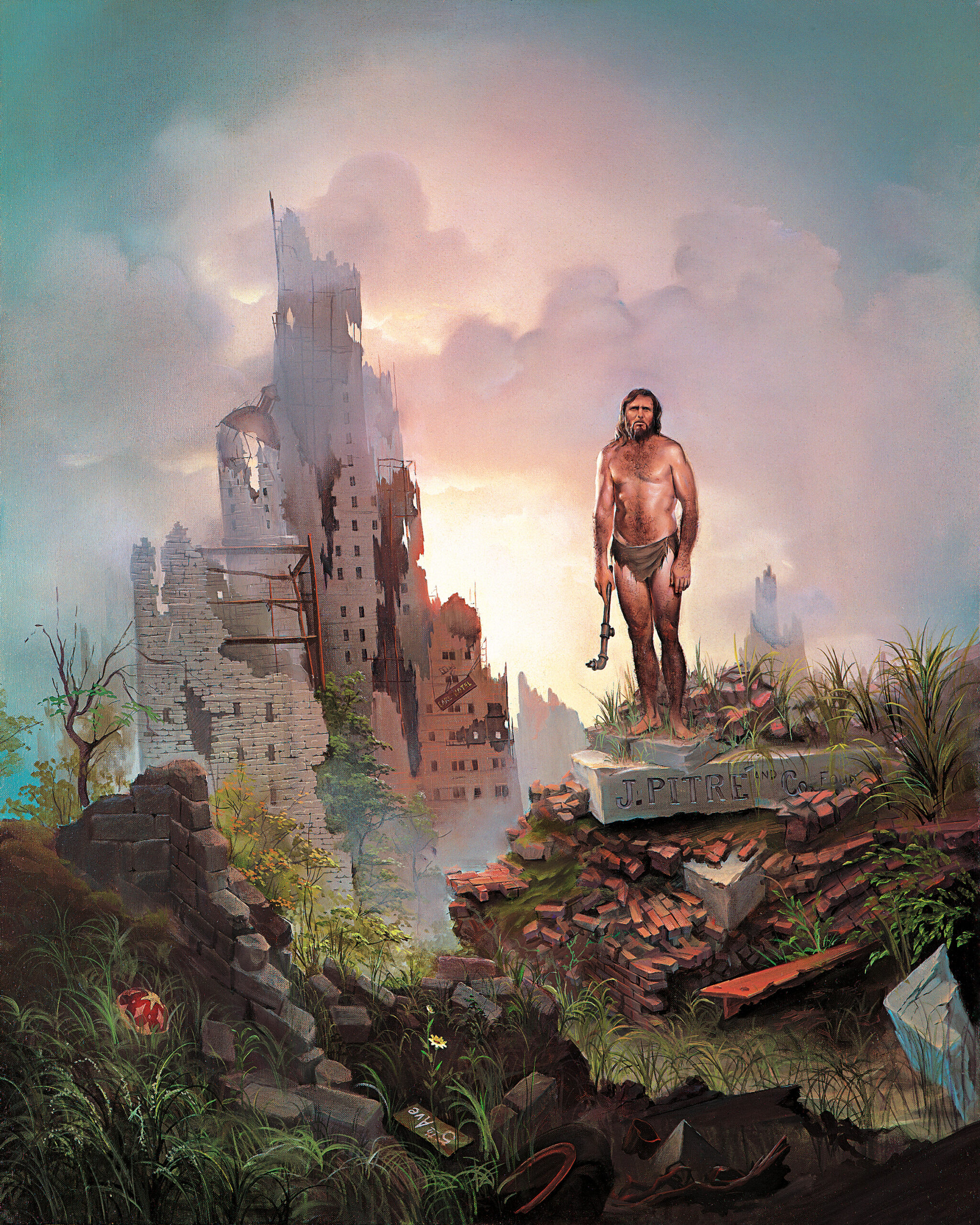
A New Dawn came from a place of deep unrest—painted while John Pitre was serving in the Special Forces of the National Guard during one of the most dangerous moments in modern history. The early 1960s were defined by the Cold War, and by 1962, the Cuban Missile Crisis had brought the world to the edge of total annihilation.
Russia had placed nuclear weapons in Cuba—right at America’s back door. Both the United States and the Soviet Union held more than a thousand nuclear warheads pointed at one another. Pitre and his unit were called up repeatedly, prepared for a war that felt both inevitable and senseless. The fear was constant. The tension was heavy. And like so many young men in uniform, he was forced to imagine what would remain if the world as they knew it disappeared.
So he painted it.
What emerged was not a battlefield but a prophecy.
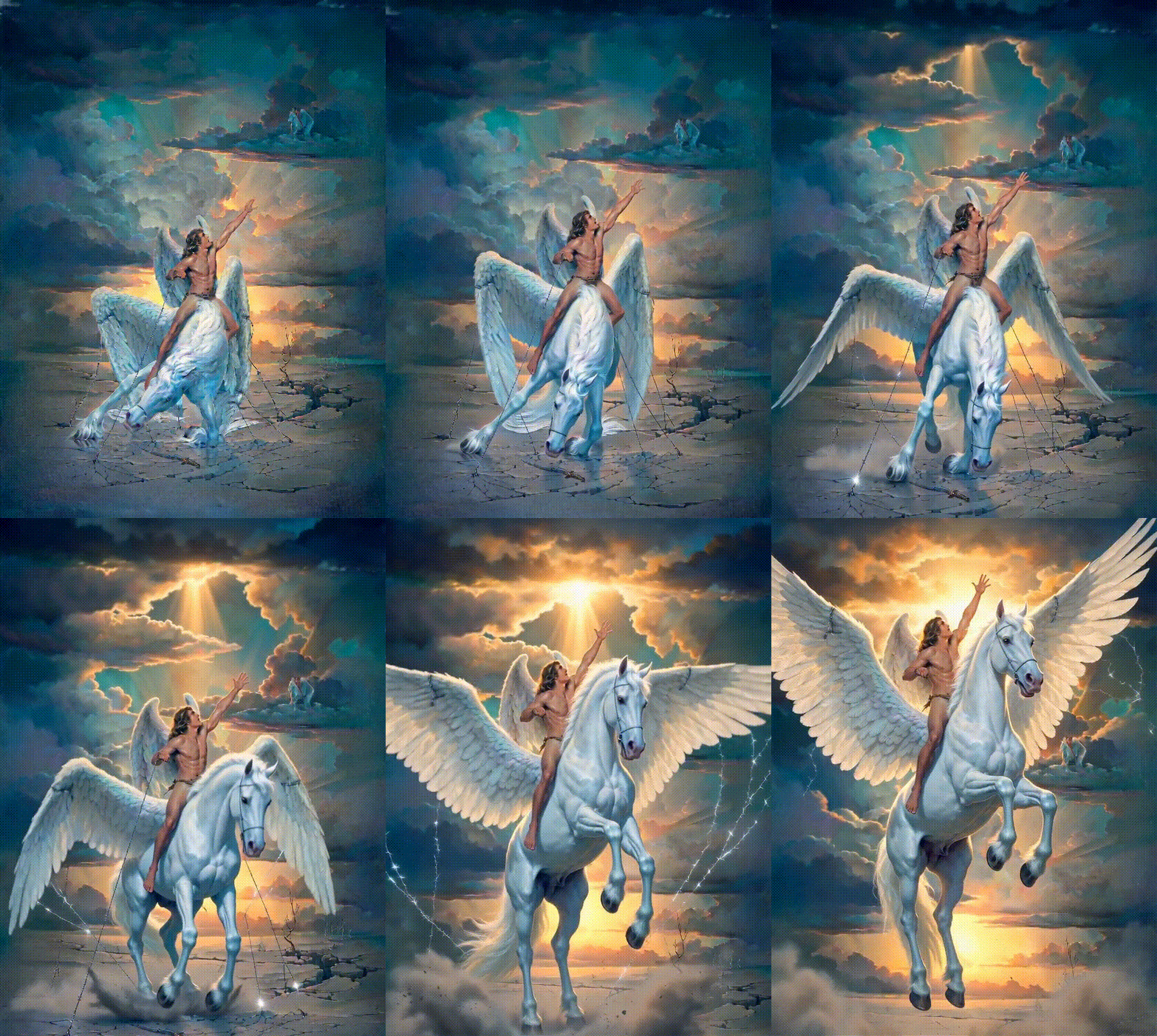
In the center of the canvas stands Pitre himself—reduced to his most primitive state, standing barefoot among the ruins of civilization. He imagined that if humanity were stripped of everything, a caveman might reach for a stick or a club to survive. But in this world, even that was gone. All that remained was a piece of pipe in his hand.
Beneath his feet is the stone of a John Pitre Incorporated building, a personal marker buried in the wreckage. Nearby sits a child’s rubber ball—a small but devastating symbol of innocence, happiness, and ordinary life that once existed there. A Fifth Avenue street sign anchors the destruction to a very specific place: lower Manhattan.
At the time, the Twin Towers had not yet been built.
That empty space—the exact location where the World Trade Center would one day rise—was simply part of the city Pitre knew. He painted its destruction decades before its construction, long before it would become the epicenter of American finance, power, and identity.
He did not know then what the future held.
But the fear he was painting was real.
During the Cuban Missile Crisis, President Kennedy faced enormous pressure from military advisors pushing for full-scale war with Russia. Across the world, Nikita Khrushchev faced the same pressure from his own side. Both leaders stood at the edge of decisions that could have ended civilization.
Instead, they chose restraint.
Through direct communication, facilitated by the now-famous hotline between Washington and Moscow, they averted disaster. Humanity was spared from what could have been World War III.
Albert Einstein once said, “I know not with what weapons World War III will be fought, but World War IV will be fought with sticks and stones.”
Pitre never forgot that.
And years later, his painting would take on a meaning no one could have predicted.
When the Twin Towers fell on September 11, 2001, A New Dawn transformed from a Cold War reflection into something far more haunting. The place he had imagined in ruin became reality. The financial center of America collapsed before the eyes of the world, and with it came the beginning of a deeper unraveling.
For Pitre, the decline had already begun after Vietnam—a slow erosion of American strength, confidence, and moral clarity. The fall of the Twin Towers was not the start but a devastating confirmation that the empire was far more fragile than people wanted to believe. It exposed the illusion of permanence, the vulnerability of power, and the cost of a nation that had failed to learn from its history.
And today, he believes, humanity stands once again at a critical point.
We learned little from the Cold War. We learned little from September 11th. The same pride, division, and blindness continue to push civilization toward the edge. The warnings remain, but so does our refusal to listen.
A New Dawn is not simply a painting about the past.
It is a warning about the future.
The figure standing in the rubble is not just a survivor of one catastrophe—it is all of us, standing at the threshold of what comes next, forced to decide whether we repeat the same destruction or finally choose a different path.
Because every civilization believes it will last forever.
Until it doesn’t.