



Few works in modern art have achieved the cultural reach of Restrictions, with over 7 million prints collected worldwide. Yet beyond its striking imagery lies a layered history—one shaped by ambition, chance, and the unexpected paths of both art and those who carry it forward.
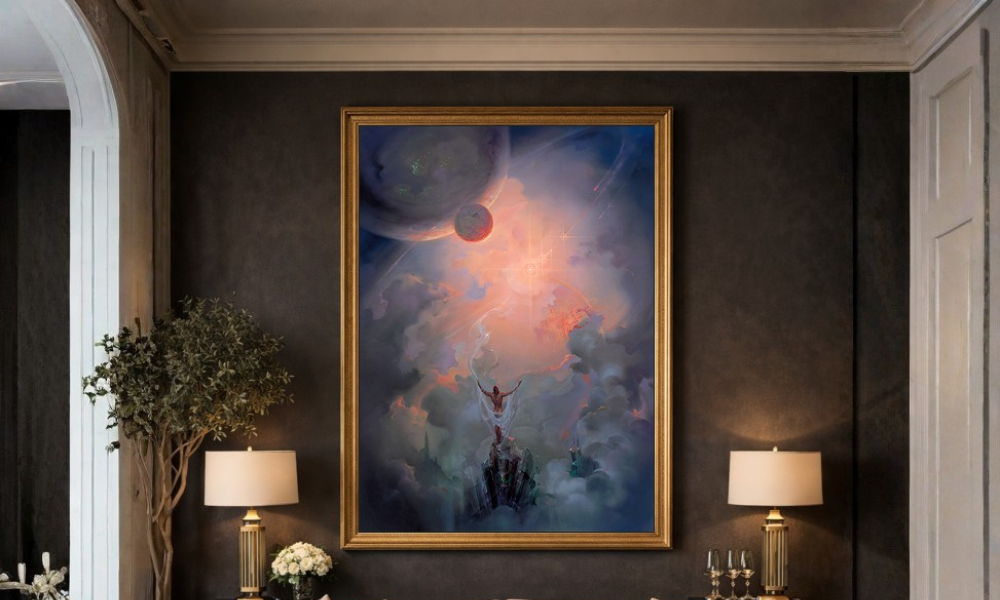
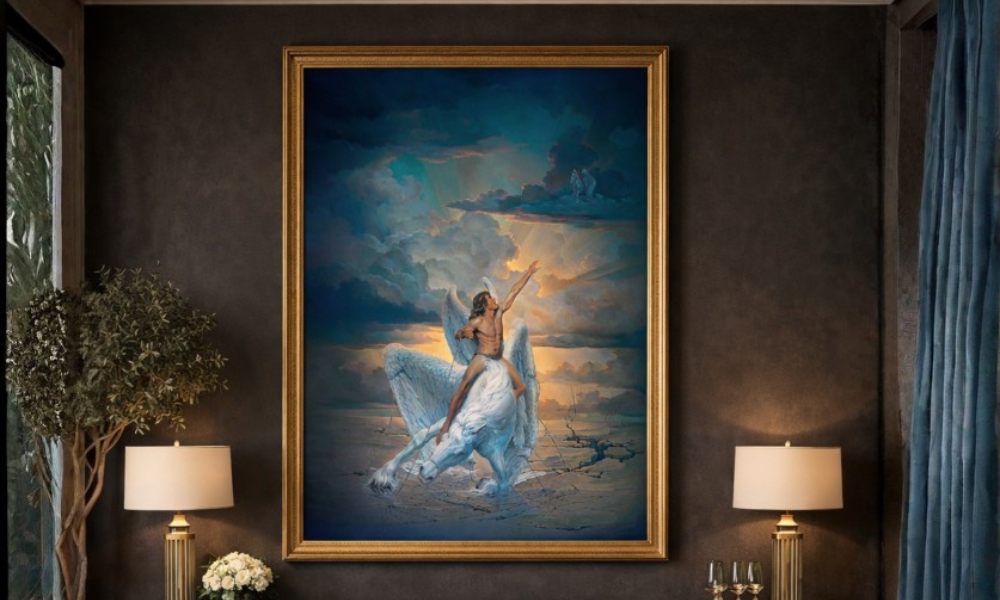
At its core, Restrictions is a meditation on transcendence. A lone figure rises on Pegasus from fractured, barren ground toward a radiant, infinite sky. The imagery captures a universal tension: the space between limitation and possibility, between where we stand and what we strive to become.
The rider represents each of us—reaching upward, refusing to remain confined. Pegasus, the mythic symbol of inspiration, becomes the vehicle of our dreams: our pursuits, our risks, our search for meaning. Below, the cracked earth reflects constraint and circumstance; above, light breaks through as a vision of clarity, hope, and the infinite.
The painting’s impact extended far beyond the canvas.
Through the efforts of Edward Curran, and with the involvement of Nelson Rockefeller, Restrictions became part of a major fundraising initiative supporting families of police officers killed in the line of duty. Thousands of prints were produced and distributed, embedding the image deeply within American culture and transforming it into a symbol of resilience and collective strength.
There were even plans to elevate the work further—positioning it for permanent display in a major New York museum. But history shifted. Rockefeller’s passing brought those plans to an abrupt end, closing what could have been a defining institutional chapter.
Yet the story of Restrictions did not end there.
In a dramatic turn, the original painting was later rescued from a fire at the MGM Grand Hotel in Las Vegas—surviving an event that could have erased it entirely. Its survival only deepened its legacy, reinforcing the very theme it represents: endurance through adversity.
Years later, the piece re-emerged through a gallery sale, ultimately acquired by a female hedge fund executive on Wall Street for more than $1.25 million—an extraordinary valuation at the time. The transaction was facilitated through established art channels, with provenance tied to collectors and representatives who understood the significance of the work.
Behind the scenes, the gallery world surrounding Restrictions carried its own mythology. Stories circulate of a striking and complex woman named Tina—closely connected to the gallery’s inner circle—whose life spanned extremes of glamour, struggle, and reinvention. Known for her sharp mind and commanding presence, she eventually played a key role in gallery operations after being given a second chance at life. Through her and others, the painting’s story continued to evolve—shared, preserved, and passed along through those who recognized its power.
Today, Restrictions stands as more than an image—it is a testament. Not only to the human desire to rise, but to the unpredictable journey of art itself. From national campaigns to near loss, from cultural icon to high-value collector piece, its path mirrors its message:
The ascent continues—no matter the obstacles.