

The Painting That Refused to Stay Grounded

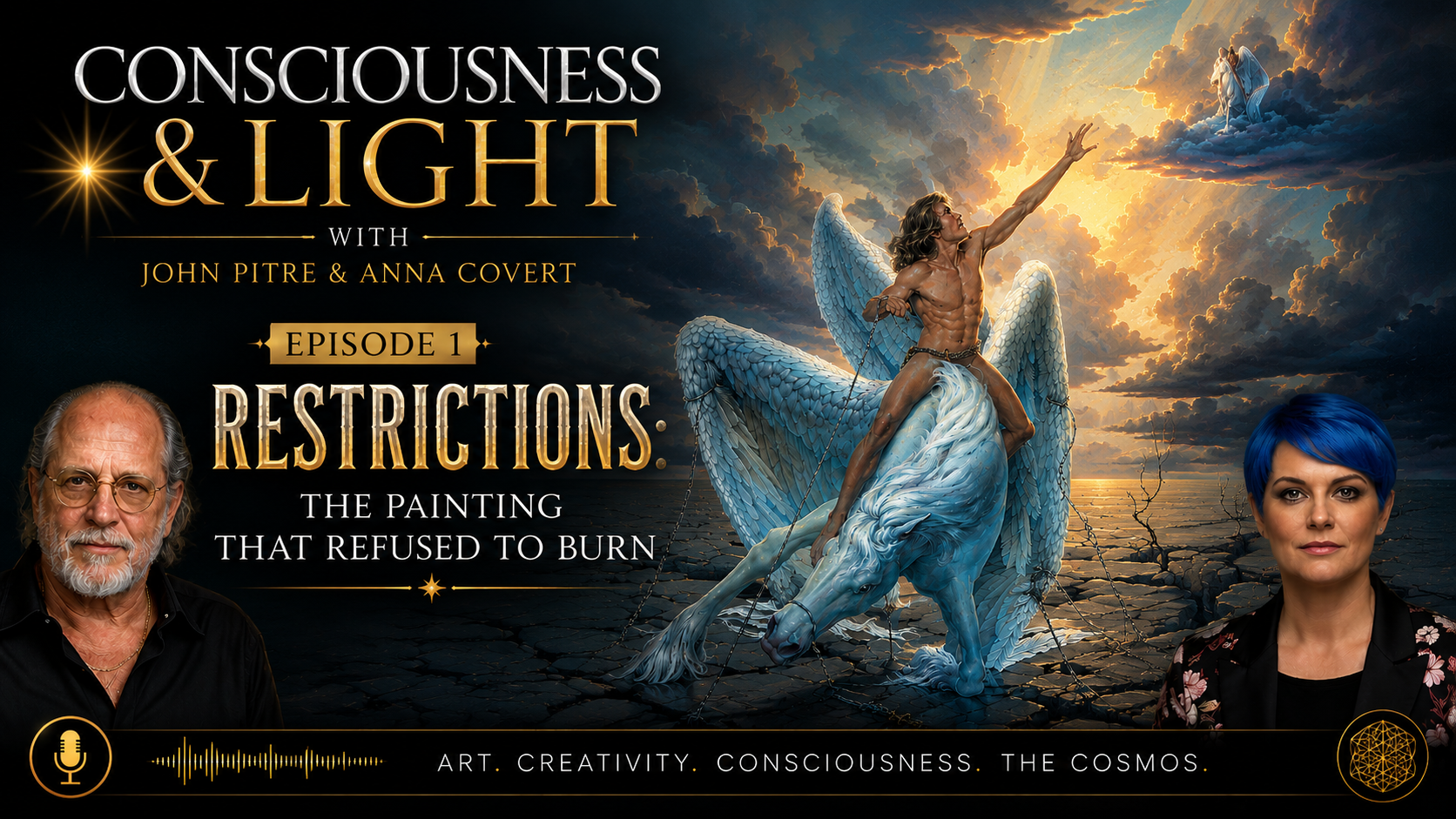
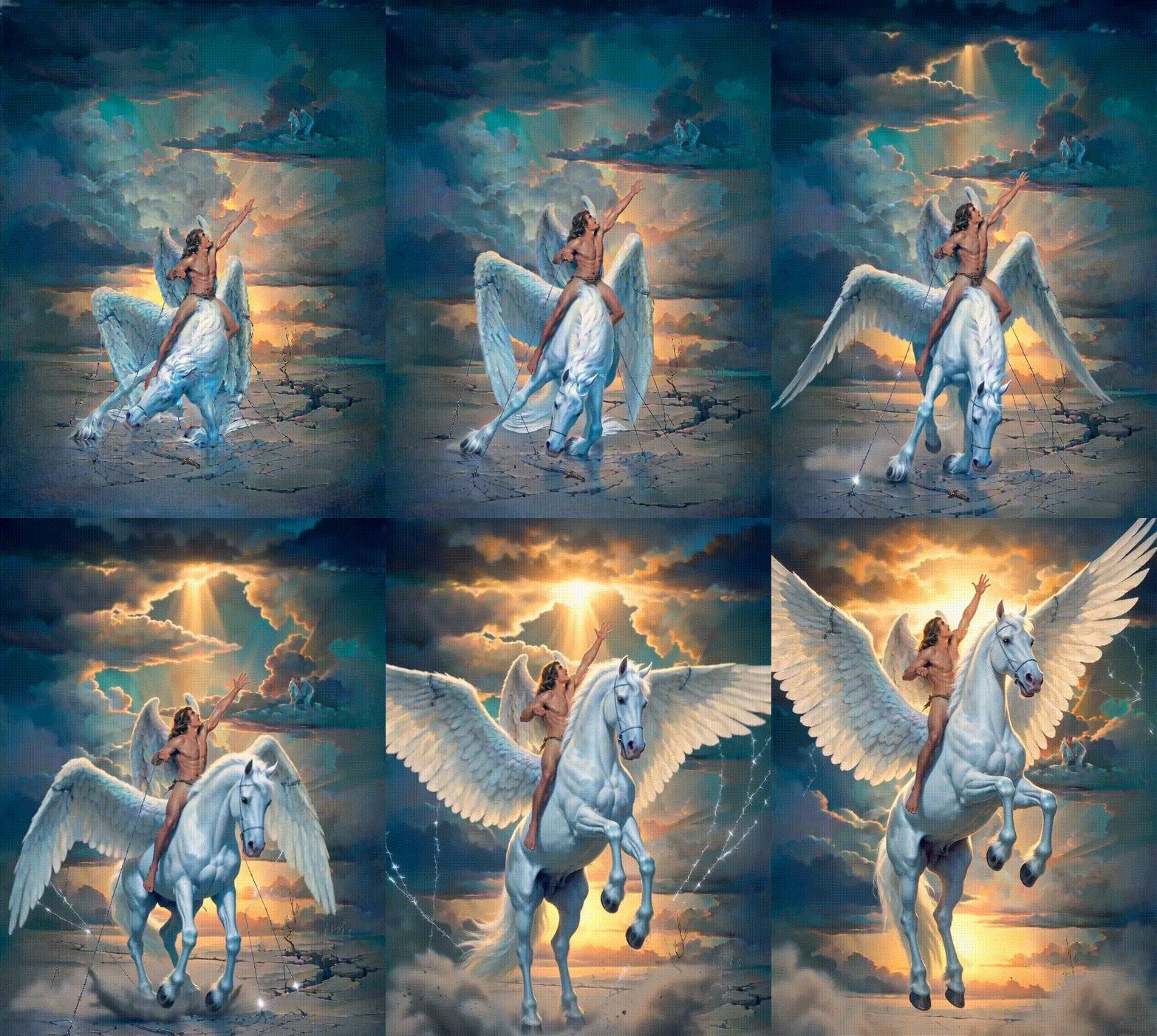
The rider in this deep message, which was made with paint and brush, stands for all of us.
Pegasus, the winged horse from mythology, is a strange symbol of the hopes, dreams, and loves we all have in life. The silver ropes tethering the rider to the earth represent the restrictions we temporarily encounter—those that can hold us to the earth and prevent us from realizing our dreams and goals.
As the rider looks skyward, he sees an image of himself in the clouds—free and unrestricted.
Few paintings have lived a story as extraordinary as Restrictions.
From Canvas to a National Symbol
Long before the fire, the collectors, and the legends of Las Vegas, the painting had already begun to take on a life far beyond the canvas.
The painting’s message—struggle, endurance, and rising beyond limitation—resonated deeply with individuals beyond the traditional art world. One of them was Edward M. Curran, a towering figure in national law enforcement leadership and president of the International Conference of Police. A commanding Irishman with the instincts of both a cop and a politician, Curran understood symbolism—and he immediately understood Restrictions.
To him, the painting represented every officer fighting through hardship, every family carrying the weight of sacrifice, and every person trying to rise above circumstances threatening to hold them down.
Curran made it his mission to use the work for something bigger.
He brought Restrictions into a major fundraising initiative supporting the families of police officers killed in the line of duty. Thousands upon thousands of prints were produced and distributed across the country, transforming the image into something far larger than a fine art print—it became a symbol of resilience and collective strength.
Rockefeller and the Museum That Almost Happened
Through Curran, the painting reached Nelson Rockefeller.
At the time, Rockefeller was one of the most powerful political figures in America, preparing for a presidential run and carrying enormous influence in both politics and culture. He immediately recognized the power of the work.
There were serious plans to place Restrictions permanently in the Metropolitan Museum of Art in New York—a defining institutional moment that would have elevated the painting to another level of American art history.
Everything was moving forward.
John gave a major presentation before the International Conference of Police. Curran was there. Rockefeller was there. The momentum was real. The museum placement was being discussed seriously, and the future of the painting seemed limitless.
Then history changed.
On January 26, 1979, Nelson Rockefeller died.
And just like that, the plans ended.
The museum placement disappeared. The political momentum vanished. What could have been one of the defining public placements of the work disappeared overnight.
But Curran kept going.
He had stacks of prints made—piles so high they seemed endless—continuing to distribute them to officers and families across the country. In fact, the prints became so desirable that even police officers themselves were quietly taking them faster than they could be handed out.
Everyone wanted one.
Because Restrictions was never just a painting.
It was hope.
It was survival.
Enter Jim
That reputation attracted another kind of attention.
As the work gained recognition, it began drawing the interest of men with extraordinary wealth—collectors who didn’t just buy art but mythology. Exotic cars, rare weapons, surreal paintings—they wanted things with a story attached to them.
One of those collectors was a man known simply as Jim.
Representatives from the West Coast approached John, insisting that a private client wanted to meet him immediately. Before he could even ask which paintings they meant, they handed him first-class plane tickets and a thick bundle of cash as a “deposit.”
A deposit for what?
They didn’t seem to care.
When he arrived in California, he was taken to an enormous estate and told only this: “You’re here to meet Jim. You’ll know him when you see him.”
For nearly three days, John waited.
The house was full of beautiful people, endless conversations, and the kind of loose extravagance that made normal life feel very far away. At one point, exhausted, he was shown to a bedroom where the “lump” under the blanket on the bed turned out not to be a person at all but piles of cash.
Finally, Jim appeared.
He was impossible to miss—towering, with long black hair down his back, sharp, intelligent, and carrying the quiet confidence of someone who never had to explain himself. He had built an empire, and money had long since stopped being something he counted.
Jim loved the paintings.
He bought Restrictions, Israel Martyrs, and several others—paying more than John had even asked for.
The MGM Grand Gallery
Then, a couple of months later, came another surprise.
John received another first-class ticket. Destination: Las Vegas.
When he arrived, a limousine took him straight to the MGM Grand Hotel, where Jim stood waiting with a smile and a new surprise.
He pointed to a beautiful gallery inside the hotel and said simply:
“It’s yours and mine. I bought it.”
Just like that, John found himself part owner of an art gallery inside one of the most famous hotels in Las Vegas.
The location was perfect. Every guest coming down the escalators passed directly by the gallery. The sales team would pull people in—tourists, high rollers, late-night wanderers—and the paintings sold fast. For months, then years, the gallery thrived.
And at the center of it all was Restrictions.
The Fire
Then came the fire.
On November 21, 1980, the MGM Grand burned in one of the most devastating hotel fires in American history. The hotel was evacuated. Smoke filled the building. Chaos took over.
Inside the gallery, the original paintings remained.
Standing outside was Tina—a glamorous, sharp, unforgettable woman who ran the gallery and knew exactly what was at stake. Police had sealed the area. No one was allowed through.
Then she spotted him.
A runner—young, striking, and built like he had been designed for speed. He was athletic in that rare way that made people stop and look—lean, powerful, effortless. The kind of person who looked like he could outrun anything.
Tina grabbed him.
“I will pay you more money right now than you’ll make in the next two years,” she told him. “I need you to go into that hotel and bring those paintings out. One at a time.”
He looked at the fire.
Then he said yes.
Not just anyone would have done it.
He sprinted past the police line before anyone could stop him, disappeared into the smoke, and emerged carrying the first painting, covered in ash and soot.
Then he went back in.
Again.
And again.
The police were ready to arrest him for crossing the emergency lines, but he was too quick. Every time they moved in, he was already gone—back into the flames or disappearing into the chaos.
Among the works rescued from the burning MGM Grand was Restrictions itself—pulled from fire and ash, surviving the very thing the painting had always symbolically challenged.
And then, just as suddenly as he appeared, the runner was gone.
No one ever found out who he was.
Still Rising
Its survival only deepened its meaning.
Years later, the original resurfaced again through gallery channels and was ultimately acquired by a female hedge fund executive on Wall Street for more than $1.25 million.
Today, Restrictions stands as more than a painting.
It shows that art can do what it was made to do: survive, rise, and refuse to stay grounded.