


A Change in Latitude
Before the collectors, before the mythology, before Miami became something people would later try to explain, John Pitre was simply trying to survive as an artist.
That part rarely gets romanticized.
In the early years, artists live on instinct and momentum. You follow whatever opens next, take the opportunity in front of you, and figure out the rest later. New York had given John a foundation, but it wasn’t where he was going to become what he was meant to become. There was too much noise, too much structure, and not enough space to explore.
Florida offered something different.
Light moved differently there. Water changed everything. John was drawn to diving—to the stillness beneath the surface, to the way forms and movement existed without interruption. It wasn’t something separate from the work. It was shaping it, quietly, in the background.
There was no clear plan.
Just movement.
And a willingness to follow it.
Finding the Right Rooms
The shift didn’t happen in a gallery.
It happened at the dock.
John had been spending time around the marinas, watching the movement, studying the people, trying to understand where the real opportunities lived. That’s when he saw it—a massive yacht sitting perfectly still in the water, larger and more commanding than anything around it. It wasn’t just a boat. It was presence.
He stood there for a while, taking it in.
“That’s it,” he said. “That’s what they care about.”
He went home and painted it.
Not casually—intentionally. Every line, every reflection, every detail dialed in so it didn’t just look like a yacht, it felt like ownership.
When it was finished, he turned to his wife.
“We’re going in.”
The place he had in mind wasn’t just any marina—it was the Lauderdale Yacht Club, one of the most exclusive clubs in the area. You didn’t just walk in there. Membership was tight, the crowd was established, and people noticed when you didn’t belong.
That didn’t stop them.
They dressed for it. Clean. Polished. Confident.
From a distance, they looked like anyone else who had every right to be there.
Up close… that was a different story.
They approached the entrance and immediately knew—this wasn’t happening the normal way. The place was locked down. Members only. No gray area.
She glanced at him.
“We’re not getting in through there.”
John didn’t hesitate.
“Then we’re not going through there.”
They circled the property, keeping their pace casual, like they were exactly where they were supposed to be. On the outside, it looked composed. On the inside, it was all calculation—timing, angles, who was watching and who wasn’t.
That’s when they saw it.
The fence.
Not impossible—but not meant to be crossed either.
He looked at her.
“You ready?”
She smiled.
“Let’s go.”
Over they went. One my one, the art passed between them like ninjas. No hesitation.
On the other side, everything changed instantly. The noise softened, the air shifted, and they stepped into a different world—one where money didn’t need to speak loudly because it was already understood.
John carried the painting under his arm like it belonged there.
They walked in.
A few people glanced over.
One man stopped them.
“Can I help you?”
John didn’t miss a beat.
“We’re looking for the owner of the yacht—we just finished a painting of it.”
The man looked at the canvas.
Then back at John.
“He just left.”
Of course he did. That was part of the plan.
John nodded, like that made perfect sense.
“Figures,” he said. “We’ve been trying to catch him.”
The tension eased.
The man gestured toward the bar.
“Well, you’re here now. Come have a drink.”
And just like that, they were in.
What started as a quick interaction turned into something else entirely. People gathered, leaned in closer, studying the painting like it meant something beyond the canvas. It moved from hand to hand, and the tone in the room shifted.
“Wow… that’s something,” one of them said.
He looked at John, then back at the painting.
“Can you do one of my boat?”
John didn’t hesitate.
“Absolutely.”
Another voice followed.
“I’d want that in my office.”
And that was the real signal.
Not a family portrait. Not something sentimental. This was different. These were the kinds of pieces that ended up behind desks in New York offices—statements of ownership, success, identity. A painting of the yacht, not the people on it.
John nodded yes to it all.
That was the moment it clicked. He had gotten in front of the right people.
And once that happened, everything started to move.
What began as a way in—a painting, a conversation, a risk—became something repeatable. Commissions followed. Introductions followed. Doors that had been closed started opening without the same resistance.
It was the beginning of momentum.
The beginning of something much bigger.
The Painting That Refused to Disappear
By the time The Stolen Armada came into his life, John was already moving through a very particular kind of world—one where introductions weren’t formal and the people around him weren’t always easy to define. He attracted all kinds. Some were serious collectors, some were curious, some just liked being close to something that felt a little different, a little unpredictable. It didn’t matter. He let them all in, and somehow, out of that mix, the right connections kept forming.
That’s how he met William Durkan.
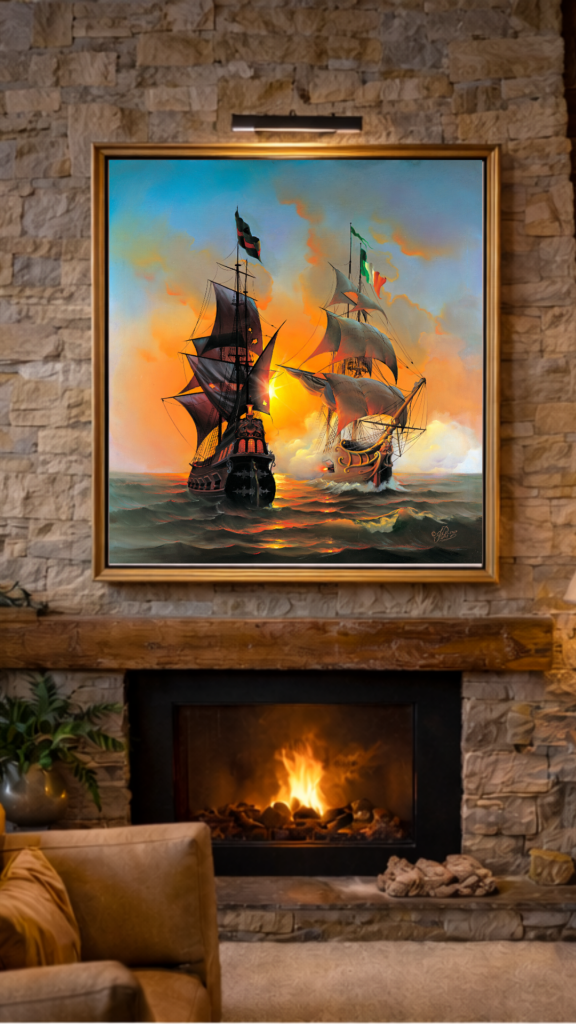
It wasn’t stiff or official. It didn’t feel like a “meeting.” It felt like most things did back then—two people in the same room, a conversation that kept going, and then that moment where the work spoke for itself. Durkan had an idea, but it wasn’t a straightforward one. He wanted two ships—one under the Irish flag, one under the Italian. It didn’t make conventional sense. Those weren’t naval powers in the way you’d expect, and that wasn’t lost on either of them. But that wasn’t the point. The idea was symbolic. Personal. Something about identity and alignment that didn’t need to be spelled out to be understood.
John didn’t question it.
He painted it.
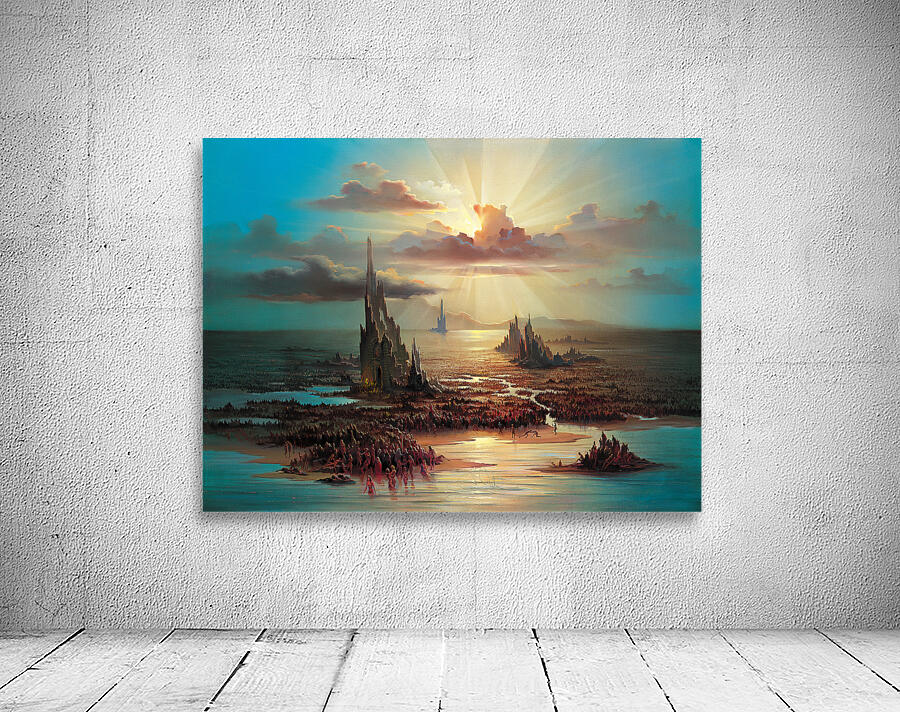
When it came together, it had a presence that was hard to ignore. The ships moved in parallel, close enough to feel connected, far enough to hold their own space. One darker, one lighter, the sky opening behind them as the light cut through. It didn’t feel like a scene you were looking at—it felt like something you had walked into midway through, like it had already been happening before you got there and would continue after you left.
It stayed with people.
And then, just as naturally as it had come into existence, it disappeared.
Somewhere in transit, moving through an airport like any other piece being shipped from one place to another, the original painting was lost. No clear explanation, no recovery—just gone. For a moment, it hung there as one of those things you don’t quite know what to do with. For most artists, that would have been the end of it.
But in John’s world, things didn’t end that cleanly.
The painting had been insured, and before long the request came back—to do it again. Not in a rushed or careless way, but with intention. There was an understanding now that hadn’t been there the first time. The original had already lived a life, however brief. It had already moved through hands, through systems, through whatever unseen path it had taken before vanishing.
So when John sat down to paint it again, he wasn’t starting from scratch.
He was returning to something.
And that changes the work.
The second version carried a different kind of weight—not heavier in a physical sense, but deeper. There’s a subtle shift when you recreate something you’ve already let go of once. You remember details differently. You feel the composition more than you think about it. It becomes less about replicating an image and more about reconnecting to what made it matter in the first place.
The result wasn’t just a replacement.
It was a continuation.
At forty by sixty inches, The Stolen Armada holds space in a way that demands attention, but it’s not just the scale that gives it that presence. It’s everything that came with it—the unusual commission, the quiet symbolism, the disappearance, and the return. It carries all of that without needing to explain any of it.
And that’s what made it valuable.
Not just as a painting, but as a story.
Because in those rooms—in that time—stories like that didn’t get lost.
They moved.
From one person to another, from one conversation to the next, building quietly until they became part of the work itself. And by then, it was never just about what was on the canvas.
It was about everything that had happened around it.