



Hustle, risk, and the first believers
The Painting That Disappeared
Some paintings become known for what is captured on the canvas. Others become inseparable from what happened to them after the final brushstroke.
The Stolen Armada is both.
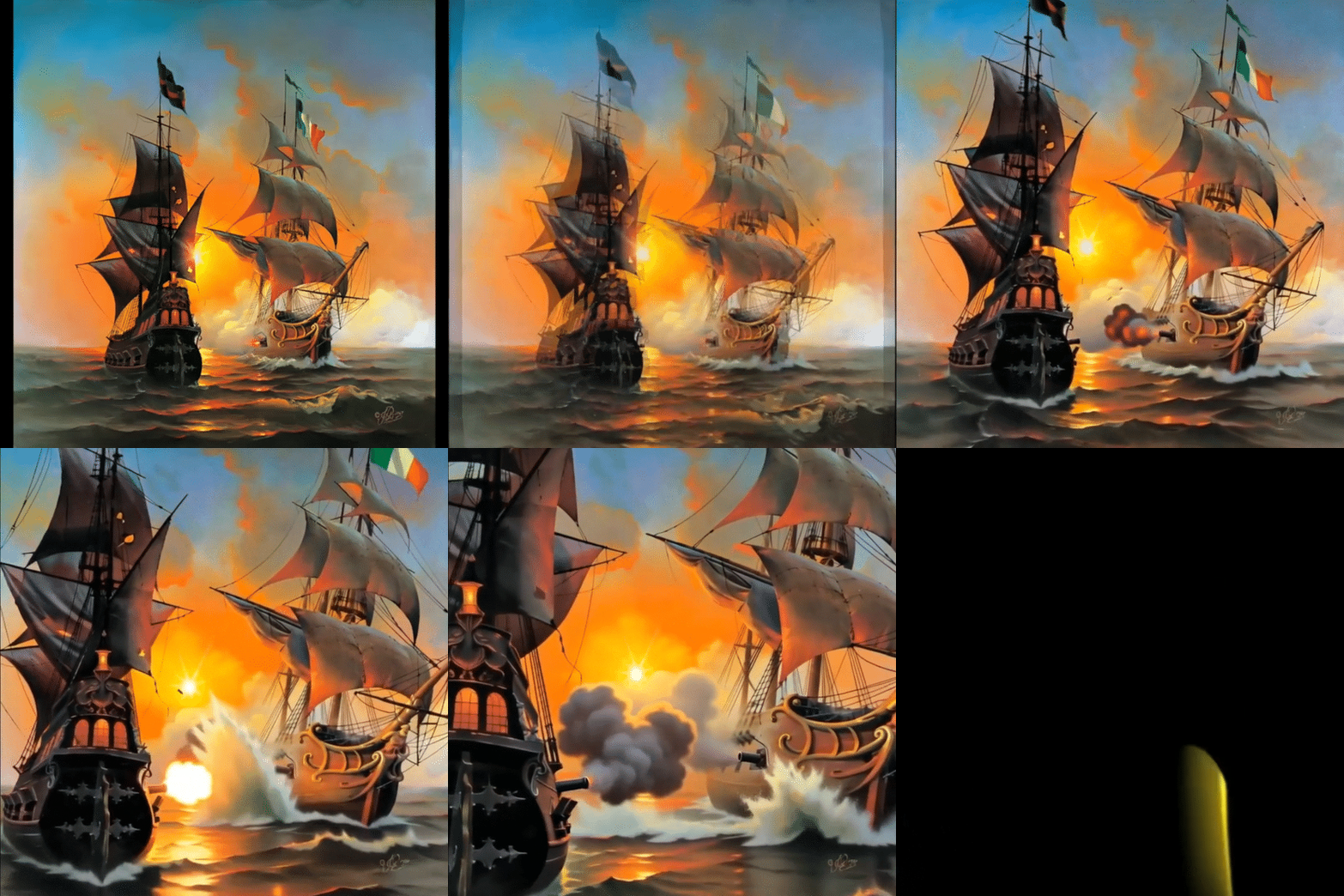
Two great ships move across the water beneath the Irish and Italian flags. One is darker, the other lighter. They travel side by side beneath a dramatic sky, close enough to feel connected but far enough apart to retain their own strength and identity.
The image carries the romance of the sea, but its real story is about movement: an artist searching for his place, the people who first believed in him, and an original painting that vanished somewhere between one airport and another.
Before the work disappeared, however, John Pitre had to find his way into the rooms where a painting like this could be imagined at all.
Before the Collectors
Before Miami became a place people would later mythologize, John was simply trying to survive as an artist.
The early years of an artistic life are rarely romantic while they are being lived. There is no certain path and no promise that talent will be enough. There is only instinct: follow the opening in front of you, take the risk, and trust that the meaning of it may become clear later.
New York had given John discipline and a foundation in classical technique. It had taught him how to see light, form, color, and balance. But it had also begun to feel crowded by expectation. There was too much noise and too little room to discover what his work might become.
Florida offered something different.
The light was sharper. The horizon felt wider. Water was everywhere, and John was drawn to it. He spent time diving beneath the surface, entering a world where sound fell away and shape, motion, and light seemed to exist without explanation.
It did not feel separate from painting. It was quietly becoming part of it.
There was no grand plan yet. Only movement, curiosity, and a willingness to go wherever the next possibility appeared.
The Yacht at the Dock
One afternoon, John was standing near the docks when he noticed a yacht unlike the others.
It was enormous, but size alone was not what held his attention. The yacht had presence. It rested on the water with the confidence of something that did not need to announce its importance because everyone around it already understood.
John studied it the way he studied a subject before painting: the sweep of its lines, the light across the hull, the reflections moving beneath it.
Then he understood what he was really looking at.
“That’s what they care about,” he thought. “That’s how they see themselves.”
He went home and painted it.
Not merely as a boat, but as a portrait of ownership. Every line was precise. Every reflection mattered. The finished canvas captured a kind of power that did not shout. It simply occupied its place in the world.
When it was finished, John turned to his wife.
“We’re going in.”
Over the Fence
The Lauderdale Yacht Club was not the kind of place a young artist could enter carrying a painting and hoping for the best. It was private, protected, and built around the quiet understanding that some people belonged there and others did not.
John and his wife dressed carefully. They looked polished, composed, and confident enough that, from a distance, no one would question them.
Then they reached the entrance.
It was locked. Members only.
“We’re not getting in this way,” she said.
John looked beyond the gate and followed the fence line with his eyes.
“Then we don’t go in this way.”
They circled the property casually, as though they had every right to be there. Beneath that calm appearance, they were watching everything: the angles, the timing, the people nearby, and the moments when no one was looking.
At the fence, John glanced at his wife.
“Ready?”
She smiled.
They climbed over.
The painting came across carefully between them, passed from one side to the other without being damaged. Then they straightened their clothes, gathered themselves, and walked toward the club as if arriving by invitation.
John carried the painting beneath his arm as though it already belonged inside.
The First Door Opens
A few people looked up when they entered. Before long, a man approached them.
“Can I help you?”
John did not hesitate.
“We’re looking for the owner of the yacht. We just finished a painting of it.”
The man studied the canvas, then looked back at John.
“He just left.”
John nodded as though they had narrowly missed someone they already knew.
“Figures. We’ve been trying to catch him.”
The suspicion faded. The man gestured toward the bar.
“Well, you’re here now. Come have a drink.”
And just like that, the door that had been closed opened from the inside.
People gathered around the painting. It passed from one set of hands to another as the conversation changed. The members were not simply looking at a yacht. They were seeing something familiar: their boats, their success, and the lives they had built reflected back to them through John’s eyes.
“Can you paint mine?” one man asked.
“Absolutely,” John said.
Another wanted a painting for his office, positioned behind his desk where every visitor would see it. That request told John something important. This was not sentiment or decoration. The painting was a statement. It was a symbol of identity and arrival.
By the time John and his wife left the club, everything had changed.
They had climbed a fence carrying one painting. They walked away with commissions, introductions, and their first glimpse of a world that would soon become part of John’s story.
It was the first real door. Once it opened, others followed.
William Durkan and the Two Ships
John began moving through a world in which introductions rarely felt formal. Collectors, businessmen, risk-takers, and curious strangers entered his orbit. Some

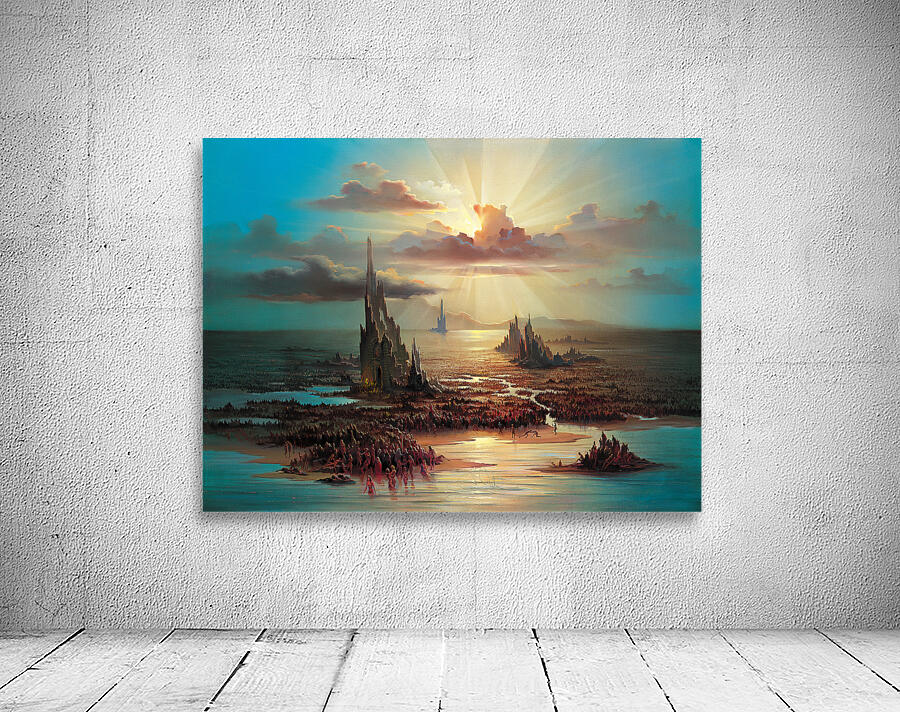
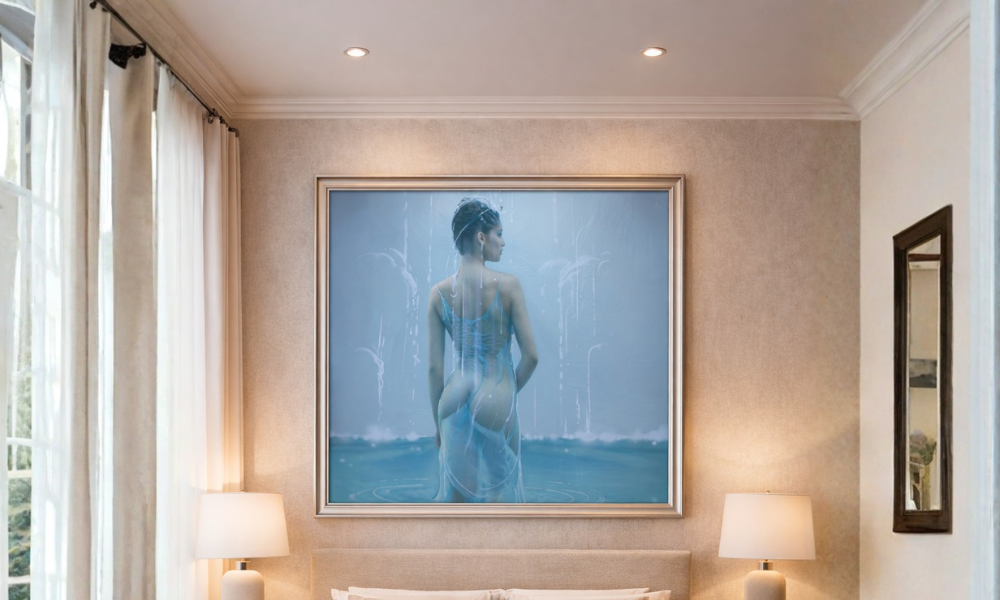
The Stolen Armada by John Pitre depicts two historic sailing ships beneath Irish and Italian flags, illuminated by a dramatic sunset. This maritime masterpiece blends symbolism, heritage, and naval rivalry, creating a striking focal point in a luxury living space.
understood art. Some understood money. Others were simply drawn to anything unusual enough to disturb the ordinary rhythm of their lives.
John welcomed them all, and from that unlikely mixture, the right connections continued to form.
One of them was William Durkan.
Their meeting was not ceremonial. It began as so many important relationships did in those years: two people in the same room, a conversation that lasted longer than expected, and a moment when the paintings revealed more than an introduction ever could.
Durkan brought John an unusual idea.
He wanted two ships painted together. One would sail beneath the Irish flag and the other beneath the Italian flag.
The request was not really about naval history. It was personal. The ships represented identity, heritage, and an alliance whose meaning did not need to be explained to anyone who understood it.
John did not question the idea.
He painted it.
As the image emerged, the ships seemed to carry histories of their own. They moved in parallel through the water, neither leading nor following. The dramatic light behind them made the scene feel as if it had begun long before the viewer arrived and would continue far beyond the edges of the canvas.
The painting had presence. People stood before it and lingered. Something in its scale, balance, and unspoken symbolism held them there.
The Original Vanishes
Then the original disappeared.
It was being shipped from one airport to another when, somewhere along the way, it vanished. There was no satisfying explanation and no recovery. A painting that had taken months of thought and labor was suddenly gone.
For many artists, that would have ended the story. The loss would have become a bitter memory: an original work misplaced by a system incapable of returning what it had taken.
But the painting was insured, and eventually a request came back for John to create it again.
Recreating a painting is not the same as copying it. The artist who returns to an image is no longer the person who first painted it. He remembers some details more clearly and feels others more deeply. What was once discovered through uncertainty can now be understood from within.
When John returned to the two ships, he was not beginning again.
He was returning to something that had already lived, disappeared, and left its mark behind.
The Second Life of The Stolen Armada
The second version of The Stolen Armada carried a weight the first had not yet had time to earn.
At forty by sixty inches, it commanded attention through its scale. But its true power came from everything surrounding it: the unusual commission, the Irish and Italian flags, the first painting’s unexplained disappearance, and John’s decision to bring the vision back to life.
The new canvas was not merely a replacement.
It was a continuation.
Its story also belonged to the years that brought John to it: the Florida water that reshaped his imagination, the yacht at the dock, the locked entrance, the fence crossed with his wife, and the strangers who became his first believers.
Those early collectors did more than purchase paintings. They gave John the freedom to keep creating before the wider art world understood what he was building. Their belief became part of the foundation beneath everything that followed.
That is why The Stolen Armada is more than a maritime scene.
It is a painting about passage: between one life and another, between exclusion and belonging, between losing something and finding a way to create it again.
The first original may have vanished without explanation. But the vision survived.
Sometimes what is stolen from us does not disappear completely. It returns transformed, carrying a history that makes its second life more powerful than its first.
Explore more of John Pitre’s work: view the John Pitre Gallery, explore his oil paintings, or discover more stories behind the paintings.